Showing posts with label colorado. Show all posts

Thursday, October 23, 2014

10,000 Hours and the Agony of Untold Stories

I quit my job last Friday.

It was one of the hardest decisions I’ve ever made, because I have the kind of job that I’ve spent my entire young life working to get. The kind of job that’s taken me to heart-pounding waterfalls in Iceland, to the tops of volcanoes in the Canary Islands, to the beaches of Oahu, to the finish line of Colorado’s Leadville Trail 100, to the San Juan mountains to camp out and hike with one of the coolest families I’ve ever met. The kind of job that has let me meet, connect with, work with, run with, learn from, write about and write for thousands of amazing people all over the world. The kind of job that has people routinely commenting on my Facebook page with comments like, “Holy best job in the world!”

How does one decide to quit a job like that?

When I was in Hawaii last year to run and write about the XTERRA World Trail-Running Championships, I crossed paths with a wonderful woman named Kim Rogers—whose full-time job was as a travel writer for Outrigger Hawaii. This essentially meant a salary and expense account to traipse around the Hawaiian islands, hiking and surfing and kayaking and meeting wonderful humans, photographing her journeys and writing about them all in meaningful ways.

And, several months ago, after six years at that job, she quit, too.

I doubt if I can articulate my own reasons as well as she did in this blog post entitled "Why I Quit the Best Job in the World," but in it, she shared a wonderful quote attributed to Maya Angelou: “There is no greater agony than bearing an untold story inside you.”

When I was in elementary school, I understood this. In fact, it’s probably what got me through elementary school. I was young for my class, shy and socially awkward, an easy target for the innocent but nevertheless piercing sort of cruelty that children are capable of. In other words, I often felt grateful to escape school and go home. Though I loved learning, my favorite part of the day was composing stories in my head on my walk home each afternoon, then dashing up to my bedroom to start writing. I was brimming with novels and short stories, and they came rushing out of me with a ferocity I dream of someday recapturing in my adult life.

In his oft-quoted book, Outliers, Malcolm Gladwell suggests that mastery in any field requires approximately 10,000 hours of practice. I have no idea how many hours I’ve racked up putting pen to paper, or clacking away at a computer keyboard under the yawning emptiness of a blank Word document, but I can say this—despite majoring in creative writing in college and building a career thus far around writing-related jobs, the majority of those hours were between the ages of 7 and 17.


And I was confident back then, too. At age 10, I told my parents I wanted to publish my first book—a 50,000-word novel I’d written called Mrs. Graud. It was about a young girl befriending a hermitic, unpopular woman in the neighborhood who turns out to be quite kind, then reveals she has cancer, so the protagonist begins a fundraising campaign for the woman’s treatment. (On a sidenote, I recall drawing inspiration for this story from the Berenstain Bears Trick or Treat, in which Brother and Sister Bear bravely trick-or-treat at the house of an old woman rumored to be a witch, but who actually turns out to be very nice, as well as flush with caramel apples—which are better than Dum-Dums or Jolly Ranchers any day.)

Anyway, rather than resorting to stock responses like, “OK sure sweetie, you can do anything!” or “Haha, publish a novel at age 10? Hilarious!”, my parents told me if I was serious about getting published, I should do some research on what’s really involved.

So, I put together a 10-page (single-spaced, even) research report on how to publish a novel—preparing a manuscript, submitting a query, landing an agent, securing a contract, working with a publisher. I could learn a lot from my 10-year-old self. The report is filled with useful advice like, “An agent learns how to get the most from the publicity department, examines an author’s royalty statements, makes sure the author gets paid properly, sells subrights and licenses for a book, and is basically an author’s book’s greatest advocate. Agents are also helpful in the way that they can complain and yell at the editor about the things the author wants changed, so that the author himself won’t jeopardize his relationship with the editor.”

Outside magazine recently published a thought-provoking article by Ben Hewitt on the case for “unschooling”—a radical approach to childhood education that involves taking kids out of the classroom completely and letting them learn everything organically, “out in the real world.” It’s not in elementary school curriculum, for example, to have fifth-graders do research reports on book publishing. Not that I was ever “unschooled,” but how cool is it that I was encouraged to do something like that when I was young?

Every summer, though my parents always asked whether I wanted to attend camps or summer programs, like other kids did—and I did some (thank you YMCA in Estes Park for instilling in me a love for the mountains!)—above all, I just begged for free, unstructured time with which to write. And, I do wonder: Would I be the writer I am today without the thousands of hours I spent holed up with my imagination, exploring the characters I’d created, honing my understanding of language?

I still feel nostalgic for the reckless abandon with which I wrote when I was younger—not worrying about profitability, not worrying about how many clicks or shares something gets on the Internet, not ever doubting for a moment that my name would be on the bookshelf at Borders (RIP) by the time I hit middle school. Or high school. Or college.

Someone texted me earlier this week to say she’d heard that I’d quit my job. “Was this a long time coming?” she asked.

On one hand, no; when I took the job with Trail Runner, I certainly thought I’d stay longer than two years. I wouldn’t take back a moment of it, for I’ve grown immensely in these years—as a writer, as an editor, as a human being. And, I still plan to write plenty for Trail Runner—hopefully even more than I have the time for now.

On the other hand, yes, it was a long time coming in that I’ve spent the last two decades of my life talking about wanting to publish a book. Though I’ve been fortunate enough to tell many meaningful stories in my time at the magazine, I still have dozens more inside of me—ones longer than magazine format, ones not necessarily about trail running, ones waiting, if not demanding, to be explored.

Last week, I’d already made up my mind to give notice at my job when this happened: Midway through my 18-mile commute to work on a two-lane road, I came around a corner and had just barely enough time to swerve out of the way of a car that had crossed almost entirely over into my lane. We missed hitting one another head-on at 50mph by a matter of inches. It was just a few miles north of the spot where a young woman was killed in a head-on collision less than two months earlier. As I felt the adrenaline course through my body, my first thought was one of outrage—not at the careless driver who’d drifted across the highway, but at myself. I thought, “Damn it, if that car had hit and killed me today, I’d be so pissed that I never got to tell the world all my stories.”

Tuesday, September 9, 2014

Is ultrarunning—or any other great passion in life—sustainable?

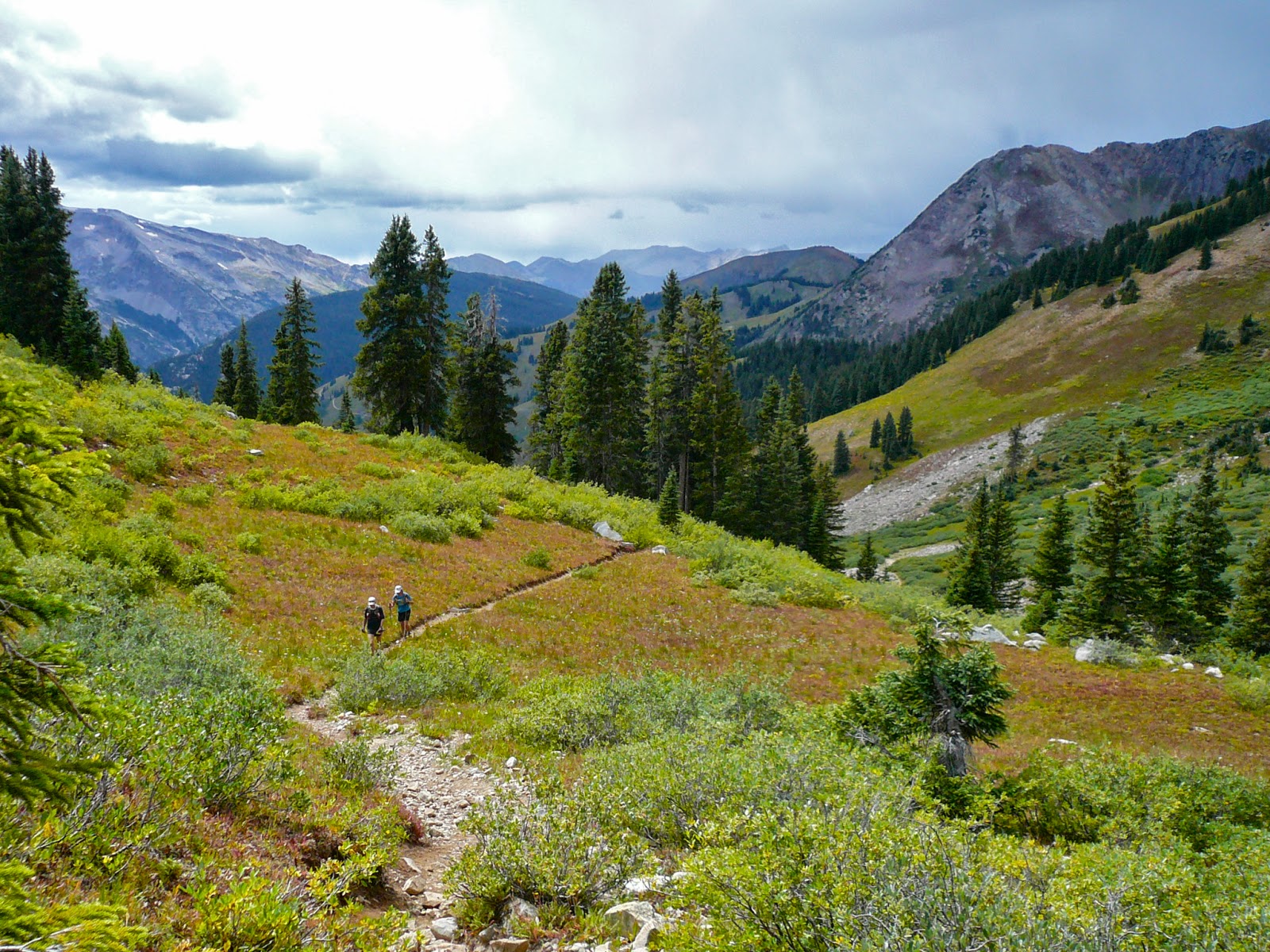
Scenes from running Colorado's infamous Four Pass Loop last Sunday.
Fall is no doubt in the air here in Colorado. The aspen leaves are paler than ever after a summer basking in the sunshine, faded from their original deep green to a sort of lime-y yellow, well on their way to the fiery hues that bring “leaf peepers” from all over the world to Colorado in droves come late September. I’ve been waking up and seeing my breath in the air in the mornings, and nearby, the tops of our local 14ers in the Elk Range have already seen their first dusting of snow.

Frost up on the trails near Aspen early in the morning on Sunday.
I admit I’ve been dreading the end of summer. Don’t get me wrong; I adore fall—if only it weren’t followed by Old Man Winter. As previously mentioned, winter in the mountains has proven rough for me, since it invariably means the end of trail-running season here, and the beginning of a six-month stretch during which I must find other sources of the things that I typically glean from running in the mountains: endorphins, stress relief, meditation, a sense of community, empowerment, goals to strive toward, races to look forward to, excuses to eat lots of food.


Because I’ve been training for months for the Bear 100 (now less than three weeks away), like any good ultrarunner I’ve been geeking out on just about all forms of data and media about the race that I can find to consume ahead of time … race reports, spreadsheets of results, photo albums, and most recently, this documentary, ‘Dancing the Bear,’ which covers the 2004 Bear race.

Here’s what struck me about the film: many of the runners featured are no longer running ultras.

(Thanks to the fairly comprehensive resource, ultrasignup.com, it’s possible to, however creepily, track these things; please note that all my following observations are based on Ultrasignup results, not on rigorous, journalistic research; if I’ve made any erroneous conclusions here, please let me know.) The winner that year, Larry O'Neil, for whom it appears the 2004 Bear was his first 100, ran one more hundo in 2008, a couple shorter-distance ultras in 2010, then nothing since then. Chris Estrem, who took second that year, never ran another ultra again.

Of the two women the film followed—who both spend much of the film waxing poetic about their love for ultrarunning, discussing how essential the sport is to who they are—one never ran another ultra after that year. The other continued running ultras (though only one more 100) sporadically until 2010, then again, no more. Another runner the film featured, then-15-year-old Jimmy Wrublik, ran a few more ultras, but stopped after 2007.

There are, of course, plenty of ultrarunners who’ve been in this sport for decades—including three who also show up in ‘Dancing the Bear.’ The first: Betsy Kalmeyer, who started running ultras in 1988, won the Bear twice (including in 2004) and most recently, at the age of 53, took second at the 2014 Hardrock 100. The second is Errol "The Rocket" Jones, who's been running ultras for more than three decades and, at age 64, is still going strong. The third is Hans Dieter-Weisshaar, who ran his first 100 in 1999 and has since bagged more than 100 100-mile finishes, including, just last year, over the span of a few months, Hardrock, Leadville, Cascade Crest, Wasatch and the Bear—at the age of 73.

We champion these inspirational figures—and rightfully so!—as proof that ultrarunning can be a lifelong sport. After all, you don’t see too many football, soccer or basketball players still competing in their 50s, 60s and 70s.

And yet, sometimes I question whether ultrarunning—particularly 100-milers—is such a sustainable sport after all, at least for most of us. I understand this is relative blasphemy for me to utter, as I am myself extraordinarily passionate about the sport. I have dozens of ultrarunner friends older than I am, who’ve been doing this for many years already, and inspire me to no end—but indulge me for a moment here.

Having not spoken to any of the 2004 Bear runners featured in the film who are apparently no longer doing ultras, I can only speculate on what made them walk away from the sport. But, consider this: even for a low-mileage (relatively speaking) ultrarunner like myself, I typically spend 10-15 hours/week running on trails. I don’t have kids or many obligations outside of my job. Though many of my ultrarunner friends have young kids and seem to make it all work, I have a hard time imagining how I could ever, on a longterm basis, balance parenthood with ultrarunning and work and other priorities in my life, like being fully present in my relationship, having time for friends and family, getting enough sleep, eating well (by making food from scratch rather than relying on processed foods), writing, reading books, traveling, and keeping some modicum of organization and cleanliness to my living space. At some point, some aspect, somewhere, has to suffer.

Trail and ultrarunning, of course, has improved my life in a myriad of ways which I’ve already expounded on at length on my blog. Yet, as a still-starry-eyed relative newcomer to the sport (I’ve only been running ultras for a little over four years now, after all), I can’t help but notice that, for many, the actual shelf life of this sport seems to be about as many years as I’ve already invested in it.

Two things stuck out to me from my interviews last year with accomplished ultrarunners Jenn Shelton and Scott Jurek for an article in Trail Runner about the folks who appeared in the bestseller Born to Run. One: when I asked Jenn what she thought the future of ultrarunning was, she was very quick to tell me that she doesn't think it's a sustainable sport for most people. She was probably the first ultrarunner I ever heard express this out loud, since most of us like to talk about how of course ultrarunning is exploding in popularity and will continue to do so indefinitely because, duh, it’s the best sport in the world. But Jenn … Jenn just said, “It's hard to say anything without looking like a jerk, but I'm not sure it's meant to be a really popular sport. The time commitment to properly train is well beyond most people's lifestyle."

When I spoke with Scott, he spoke at length about the personal burnout he feels surrounding racing: “Do I get as much out of racing, to go after a time or a win anymore? I don’t know. It’s harder to have that ego now. I’ve enjoyed that pressure in the past, because it’s pushed me beyond boundaries, but at the same time, it gets harder as I’ve gone to the well so many times.”

This is probably what I find most compelling—the sheer time and mental energy we devote to plodding through the mountains for hours, sometimes days, on end. How deep are our reserves, and what do we do when they run out? How long can we find meaning and purpose in doing, essentially, the same thing over and over again? How long can we make running our highest (or almost highest) priority, at the necessary expense of other aspects of our lives? And, if we someday find we’ve lost some of our passion, how do we renegotiate whole identities that have been built upon a foundation of running?


Every run (as with all activities we choose to participate in) is, ultimately, a decision to not to do something else, whether that means relatively unproductive alternatives, as many drug-addicts-or-alcoholics-or-otherwise-turned-ultrarunners can attest to—or whether it means valuable ones, such as spending time with our families or (non-runner) friends.

My friend Jenn Hughes recently grappled with this very issue in a beautifully written, heart-wrenching blog post about running the Fat Dog 120 in Canada. At the start line, her 7-year-old son, Colin, protested to her: “You’re always leaving me.” Haunted by those words for all 120 miles until the finish, she writes, “I crossed rivers, ran through fields of heather, met new friends, and graciously accepted handmade food made from far flung aid stations … but it all felt like a game, a silly diversion … It was the most empty, neutral, underwhelming race finish I could have ever imagined, devoid of any excitement after all the pain I had just gone through. What exactly was the point?”
While poking around on Google for beta on the Bear 100, I also stumbled on the blog of Shawna Tompkins, who used to race up to a dozen ultras a year—and win most of them. I was surprised to learn she hasn’t (as far as I can tell, from Ultrasignup) raced any ultras since her second-place finish at the 2012 Bear. In the most recent entry on her blog, from August 2012, she writes about DNFing at both White River 50 and Cascade Crest 100 that summer, after having won the San Diego 100 in June: “I am not really sure what is going on, but my inner strength seems to be laying on the trail at San Diego or something …  I cannot figure out my thoughts!  Sure not good at this stuff.  Work hard, be tough, it all pays off.  What do you do with yourself if you don't feel like working hard?  Where does that satisfaction come from then?”

It’s hard for me to read things like this, because I’m currently so enamored with the idea of making a lifelong go of this and continuing to draw the joy and meaning from it that I currently do—but who can know? Maybe it’s not bound to be a lifelong sport for many of us, after all. Maybe it’s just something that grabs hold of us for a while, takes us for a wild ride, teaches us strength and resilience, connects us with a slew of amazing fellow humans, then lets us go again, scattering us back out into the world like dandelion seeds to apply to the rest of our lives everything we’ve learned on our sleep-deprived stumbles through the woods.

Or, maybe there's middle ground to be found. Perhaps the solution lies among the yellowing leaves fluttering to the ground outside my window right now. Last fall, my editor colleague at Rock and Ice, Jeff (who loves climbing more than anyone I know) mentioned that, much as he laments the end of rock-climbing season here, he embraces winter, too. It grants him the opportunity to turn inward and focus on other passions for a season—in his case, music and writing.


So, maybe winter in Colorado is just the universe stepping in to help protect me from running burnout—telling me to chill out, take a necessary breather for a few months, reallocate those 10-15 hours/week to other passions so that, come spring, I may return to the trails with a full and eager heart. Absence, after all, makes the heart grow fonder.

But, in the meantime ... I can't help but be anything but psyched for the Bear a few weeks from now.

Standing at the edge of Logan Canyon, home of the Bear 100, after a course-scouting training run last month.

Monday, June 23, 2014

San Juan Solstice 50 Race Report

Is there a better way to spend the summer solstice than playing all day long in the mountains?


I think not.

At the risk of assuming knowledge, here's a quick primer on the San Juan Solstice 50 (formerly the Lake City 50) that happened last Saturday:
 - 50-mile loop course through remote terrain, starting and ending in the town of Lake City
 - 12,856 feet of vertical ascent
 - Low point of 8,671 feet
 - High point of 13,334 feet
 - 16-hour cutoff
 - Sometimes called "Mini Hardrock"
 - Course profile:


San Juan Solstice fills up months in advance, literally within minutes of online registration openingso, on the recommendation of my friend Annie who'd run this one in the past and thought I'd enjoy it, I registered months ago without really doing my research. (These "moments of optimistic impulse," particularly in relation to ultrarunning, are not out of character for me.) Sign up now, ask questions later.

My first inkling of what I'd signed up for came at the Sageburner 50K in Gunnison a couple months ago, when a racer from Lake City mentioned that the snowpack there was unusually high this year and that he wasn't sure the original course would be runnable by mid June.

Somehow, this possibility hadn't really crossed my mind. There's still snow above 11,000 feet on the trail out my back door right now, so I'm not sure why I thought there wouldn't be snow at 13,000 feet in mid-June somewhere else in Colorado, but somehow that just didn't click. Sure enough, then came the pre-race emails from Race Director Jerry Gray, saying we might need to run a modified course at lower elevation to avoid the obscenely high creek crossings and deep snowfields plaguing the true SJS 50 course last month. He'd monitor the snow melt and let us know.

It wasn't until six days before the race that we got final word: things were still crazy up there, but the snow was melting fast, so we'd run the original course, creek crossings and snowfields and all.

Hmm. For the first time since I'd registered, I read the race website more carefully and learned all sorts of interesting things: in fact, there'd be roughly a dozen icy, knee- to waist-deep creek crossings in the first few miles. There'd be bushwhacking and scree-field surfing and post holing and glissading and all sorts of other verbs that, in years past, I'd considered only vaguely related to trail running.

A few of the images that can be found on the San Juan Solstice 50 race website.
Furthermore, there are pieces of advice on the race website like, "If it goes electric, get off the ridge!" and "It is a very wise idea to buy a CORSAR [Colorado Search and Rescue] card ... that will help pay for your rescue."

Also, this running-at-13,000-feet thing. In my head, beforehand, I think I was all, "Oh yeah, I live at altitude in the mountains in Colorado; I'm pretty much made of red blood cells now, so no problem."

Haha.

Turns out, 13,000 feet is still a heck of a lot higher than 7,000 feet. The lowest point (metaphorically) for me on Saturday came shortly after the highest point (literally) in the race, the 13,334-foot Coney Peak. At this point, mile 24ish, we'd already done the bulk of the race's major climbing and now faced roughly 13 more miles of staying above 11,000 feet. As one of the race's more Colorado-appropriate mottos goes: "Get high, stay high."

High did not feel so good to me, though. Not one bit. In fact, aside from the glorious views and the nice folks I met along the way, very little about the first 30 miles felt good to me.

Let's begin with the creek crossings, which were every bit as icy and raging as promised. The first couple of them were excitingall "Whoo, we're splashing through a creek, it's the summer solstice, isn't this awesome?!"but then, as my legs got progressively more numb with each crossing, the novelty wore off. The crossings got deeper and more harrowing. Some had logs or ropes to hold on to, but the deepest one of all (which, I was told later, nearly swept away at least one or two smaller-bodied runners) had nothing at all to assist with a safe crossing, save the kindly, patiently extended hands of the runners in front of and behind me, including my wonderful friend Annie.

By the time all the creek crossings were over, my legs felt like popsiclesstiff and frozen. My heart (and I mean this in a physical sense) also felt very cold, like it couldn't pump oxygen fast enough to the rest of my body. I was sluggish until we made it through the first major aid station, popped out above tree line and the sun began peeking through the morning clouds, bathing us with its rays.


Here, it was evident who was a San Juan vet and who was a starstruck newb. Falling into the latter category, I was brimming over with oohs and ahhs and the occasional disbelieving, ecstatic profanity as every switchback took us higher, and snow-capped peaks rose up around us like castles in the sky.


From the beginning, my stomach had been grumpy and I felt a bit dizzy, but otherwise, I was doing all right. The first downhill was a huge boonoff I went, unleashed, and to my tremendous delight, the first runner I flew by called out after me, "Wow, wow! Like a GAZELLE!"

Day. Made.

I would have liked to have stopped to tell him that I like to think of the gazelle as my spirit animal, and that, in 2012, I named one of my personal projects for the new year "The Gazelle Project," which had everything to do with devoting my life more wholly to the sport of trail running.

One of the things that struck me most about running the Leadville Trail 100 last year was how grumpy and even antagonistic some runners were toward one another, including several who made nasty comments to me as I passed them on downhills. (My favorite: a sarcastic, "Nice work trashing your quads!")

The runners at San Juan couldn't have been more different. In my experience, even those of us suffering deep in our individual pain caves throughout the day were still kind and decent to one another. (Thankfully, like nearly every other trail race I've ever run ... )

When I made it to the top of Coney Peak, a fellow runner who was stopped at the summit asked me if I wouldn't mind stuffing his jacket away in his pack for him. I was more than happy to do so, then I asked if he wouldn't mind taking a photo of me at the summit with my camera. Unless one of my parents reminds me of some long-forgotten adventure when I was a wee one, it's the highest elevation I've ever been in my life.


As the runner was snapping a shot of me, another runner (if my admittedly fuzzy memory of the moment serves me right, it was Lucky, the owner of the Raven's Rest hostel in Lake City) approached the summit and said brightly, "Oh, are you two together? Do you want me to take a picture of you both?"

What a gentleman, even as the first runner and I laughed and shook our heads.

On the way up to Coney, I'd leapfrogged with two of my friends, accomplished runners and fellow Pacific-Northwesterner-for-a-while-turned-Coloradoans, Ben (well, Steve's friend whom I've co-opted, who now lives in Telluride) and Annie (OK, Annie's a Colorado native originally, but she did a solid stint working in Olympic National Park before moving back to the homeland near Aspen.) Annie's husband, Jeason, also a former Northwesterner, was much further up in the pack, getting in a solid training run before Hardrock next month.


Ben leads the way.
Annie, trekking poles up, in her perpetual great mood.
Annie and Ben kept me in good spirits on the climbs, as did the runners around usseasoned SJS 50 vets like the indomitable Roger Jensen with his epic beard and tie-dye shorts and 11-time SJS 50 finisher Annette Fortune, as well as a handful of newbies like myself. At some point on the second climb, the man who'd called me a gazelle caught up to me again, and we fell into stepBill and I continued to chat away about writing and editing and goodness knows what else for several miles. So many good, friendly people; much as I love my solo runs and adventures in the backcountry, the trail-running community has always been, first and foremost, what I love about this sport.

Then along came the stretch on the Continental Divide. Following a heck of a lot of climbing, it offered a huge section of runnable, net-downhill (albeit very rolling), relatively non-technical terrain. I was psyched and feeling pretty good for the first time all day.


Then, out of nowhere, after a steep descent through scree, a wave of intense nausea overtook me.

I guess there was a "trail" in there somewhere for getting down.
All of the sudden, I was on my hands and knees, dry retching onto the tundra. Fortunately there was enough space between me and the next runner that no one had to witness this display, which lasted about one minute in total. After about a dozen dry heaves and a mild panic attack about my body rebelling so violently and so unexpectedly, I calmed myself, ate a blueberry rice cake (thank you, FeedZone Portables cookbook), sipped some water and Acli-mate, got up and started running again. Just like that, I felt better.

Some further gratitudes: there were no lightning storms on Saturday. This was my worst fear going into a race like this that takes place so much above tree line. The skies went dark for a moment in the early afternoon and it rain/snow/hailed on me for approximately 20 seconds, but that was really it as far as inclement weather; by the time I'd yanked my jacket out from the bungee on my pack and pulled it on, the "storm" was already over. The rest of the day, we lucked out with intermittent sun and generally cool, overcast skies.

Remember in my last blog entry, last week, when I wrote about how I'd be happy if I never had to post-hole another day in my life? Hahaha.
Steve and Carmel, the hero crew team responsible for seeing me and Ben through our respective races, greeted me at the 40-mile mark at Slumgullion aid station with big smiles and a plate of salted avocado and bananas. Pacers are allowed for the final stretch, so Steve jumped in to run the last 10 miles with me. I was already feeling (relatively) like a million bucks at this pointdry socks and shoes, no more nausea, no more getting above 11,200 feet, and feeling in the home stretchbut it was especially terrific to have Steve's company for the final 1,700-foot climb and descent through Vickers Ranch and back into town.

Like a bat out of hell, I went crashing out of Slumgullion, so utterly stoked by how strong I felt at that point that I blasted right past a flagged turn in the course. (Sound familiar?) Go figure; it wouldn't be a real race if I hadn't gotten lost at some point or another, despite the course being perfectly well marked the whole way. I fortunately dead-ended at a creek almost immediately, realized I'd missed a turn, ran back up to the turnoff and got back on course.

The last 10 miles were nothing but fun. No, really. Just as had been my hope for this race, I felt strong and properly trained and, above all, joyful. I cruised hard on the technical descent back toward town, and was delighted to cross the finish line in 13:15ish (still not sure my exact time), at least an hour or two faster than I was expecting.

Last year, I ran just two trail racesthe Transvulcania 83K in Spain's Canary Islands, and Colorado's own Leadville Trail 100. On a personal level already discussed at length here in my blog, both races kicked my ass; it was my hope that this year I could finally experience feeling good at the finish line of a race again, rather than just destroyed.

Happily, mission accomplished.

On a more general level, Leadville and Transvulcania were each special and amazing in their own ways. Ultimately, though, with 1,000ish runners apiece and massive fanfare (or as "massive" as fanfare gets in the ultrarunning world, ala balloon arches, sound systems, media coverage, etc), neither race in its modern rendition has much in common with the low-key, laid-back races that made me fall in love with this sport in the first place. (To name a few, my first volunteer gig at Ben Holmes' PsychoPsummer 50K, my first trail race at James Varner's Orcas Island 25/50K, and my first ultra at Bruce Cyra, Kevin and Claudine Kim-Murphy's Vashon Ultra 50K.)

I was happy not to see a speck of litter, not even a lone GU gel tab, anywhere on the SJS course. In my experience, runners were friendly to one another, cheering each other on all day long, offering helping hands at the creek crossings, stopping to check in with those pulled over in pain or exhaustion on the side of the trail.

The aid stations were unbelievably dialed, filled with some of the most wonderful volunteers I've ever met; my drop bags were delivered without asking, my bottle/hydration pack refilled to my specifications in a matter of seconds. With 200+ runners on course, I usually had company if I wanted it, though toward the end, Steve and I also enjoyed some glorious miles entirely on our own, so spread apart had we racers become.

All the race proceeds went to benefit the Lake City Volunteer EMTs.

Bravo to all the folks who made this race happenthe RD, volunteers, runners, crews, sweepers, Lake City locals and morefor putting on such a wonderful, challenging event in some of the world's most beautiful mountains. I feel blessed to have been a part of it all.

Our base camp for the weekend: Wupperman Campground overlooking Lake San Cristobal,  just a few miles outside of Lake City proper.
Sucker for swag: Finisher's cap, age-group award dog tags, plus a sweet cutting board from the Lake City general store and a bottle of Syrah donated by Elkhorn Liquors that I scored in the post-race raffle.

Nothing but gratitude for another glorious day in the mountains.

Friday, December 20, 2013

Falling in and out of love, and back in again, with running

Sunrise on Mt. Si run with Glenn and Jenn
Remember when this blog used to be nothing but rambling, endorphin-fueled odes to my trail-running adventures in Washington's Cascade Mountains? I do.

Running Bandera Mountain with good friends in WA
Now that this year is almost over, I have to admit something: I spent most of 2013 not really enjoying running.

Don't worry; this ends well. But first, some truth: Moving to Colorado (a year ago now!) has been hard on my running.

In my second week as associate editor for Trail Runner at the beginning of this year, I attended the winter Outdoor Retailer trade show. I had never met Bryon Powell, for whom I'd done a smidge of writing in 2012, before then, but we coordinated to meet up for a run through the icy streets of Salt Lake City one morning before the trade show floor opened. During our run, he asked me about my running goals for 2013. I shrugged the question off and told him I planned to focus on my job in the coming year first and foremost; running would necessarily come second. Plus, in the 10 days or so that I'd been living at altitude at that point, my lungs felt like death every time I tried to runso, I found myself dreading runs more often than not.

Bryon, wise as he is, gave me a piece of advice that morning: Don't let anything get in the way of your running.

But, I did. I have. Not my job, thoughafter all, there are trails two minutes from my office, and I am surrounded all day long by fellow runners. I couldn't have a more flexible, accommodating work environment in terms of allowing me ample time, whenever I want it, to go run. (When Trail Runner first posted the job opening on their Facebook page, someone joked in the comments, "Are three-hour lunchtime runs permitted?" Yes. Yes, they are.)

Rather, I let other things get in the way of my running: the altitude being hard. Feeling intimidated by trail races in Colorado. Most trails being icy and snow-covered or closed altogether for much of the year, or threatened by thunderstorms and lightning every afternoon all summer. Losing access to the supportive community of trail runners and friends I thrived on in the Pacific Northwest. Being immersed, instead, in a community of elite and semi-elite runners here in Colorado who view running more as a competitive endeavor than a social activity. Not being able to keep up on runs with anyone here.

I only ran two ultras in 2013, only a fraction of the seven ultras I ran in 2012, not counting four more that year at which I paced someone 35+ miles. This year, I was undertrained for both the races I did runTransvulcania 83K and the Leadville Trail 100simply because I'd been having such a hard time dragging myself out the door to train. Let me tell you: running 50 or 100 miles when you haven't really trained is not a great game plan.

You know what I miss? The feeling I had in 2012 at the Vashon 50K, when I'd worked hard and shaved nearly 40 minutes off my time from the previous two years. The feeling I had just a few weeks after that, finishing my first 50-miler, White River, a full hour faster than I'd expected/hoped to, because I'd trained my butt off for it.

Sheer bliss at the finish line of the White River 50
See that smile on my face? I want that back! It comes from having spent months preparing myself for that race by doing something that brings me exceptional joyrunning in the mountains.

And, slowly but surely, my passion is returning. It's been building back for months nowmy ability to enjoy running again, to reach the same highs I was so accustomed to in the Northwest, to familiarize myself enough with the trails out here that they've begun to feel like home in the same way that Cougar Mountain and Mt. Si did to me in Washington.

The running out my back door here ain't shabby. This view from 12,700 feet is all doused in snow now, but Colorado's high country is, no doubt, incredible. I feel lucky to be where I am.
Lungs are finally fully adjusted. I've found some wonderful women out here whose pace is roughly on par with mine, with whom I can run trails (and cross-country ski, too!). I'm learning to suck it up when it's below zero here with a foot of snow on the ground, and get outside for a run anyway. I'm not letting myself work through the lunchtime hour anymore, but rather, making sure I get out, even if it's just for a short one.

I'm starting to plan out my 2014 race/adventure calendar and I couldn't be more excited about setting goals and getting out in the mountains every day to work toward achieving them!

Smiles at the finish line, here I come.

Saturday, November 16, 2013

What It Means to Tell the Truth

When I was little, I was very insistent about the fact that I wanted to be a writer when I grew up—but not a journalist. An author, yes; a novelist, yes. As the fiercely independent daughter of a longtime newspaper editor, I wanted to follow my own dream, not just in his footsteps.

When I took a journalism class my freshman year in high school, I was turned off by all of its rules, the legality of it, and what I perceived to be the utter squashing of creativity. After a year writing journalism-style pieces for my high school's yearbook, I quit yearbook staff to help cull art and poetry for the literary magazine instead.

I spent my college years writing poetry and short stories, wrangling the nuances of the English language, honing the craft of storytelling. To my surprise, though, of all the writing workshops I took, my 300-level creative nonfiction workshop was my favorite. Family and friends asked me, But, what IS creative nonfiction? Isn't that an oxymoron? Or, Isn't that just journalism?

Well, for me, no. When I was 19, "creative nonfiction" was really just a glorified term for "writing therapy." In other words, I wrote a lot of either (1) angsty, teen memoir-style babble, or (2) David Sedaris-esque attempts to poke fun at my own experiences, my relationships, my family. Not that anything was wrong with those approaches; I was, after all, just writing what I knew at the time. I got plenty of practice fine-tuning my wordsmithing abilities through those writing projects. Above all, writing about my own experiences instead of others' seemed a good way to avoid becoming a journalist.

Fast forward to the past year of my life, during which I've found the books that most capture my attention are not the novels I used to so love, but rather, investigative nonfiction stories like Tom Kizzia's 'Pilgrim's Wilderness,' Nicholas Kristof's 'Half the Sky,' Laura Hillenbrand's 'Unbroken.' And, due to the nature of at least some of the writing projects I've tackled in my professional life, it seems that I have become a journalist after all.

In August, I ran the historic Leadville Trail 100 race, in anticipation of writing an upcoming feature story on it for Trail Runner. Aside from sharing a few anecdotes from my own experience, though, I am not all that interested in telling my own same-old, same-old ultramarathon narrative (i.e. I ran for a long time! It hurt a lot! I fell apart at mile 75 and thought I'd never make it to the finish line, but with the support of my amazing pacer and crew, I did!)

Rather, I am compelled to (attempt to) tell a much bigger, far-reaching story about Leadville, its history and what happened at this year's race—a situation that has already sparked widespread controversy throughout the blogosphere and injected some real ugliness in the greater trail-running community. I'm not interested in joining the personal jabs back and forth; what I want to do is uncover the truth.

But, what I've been reminded of over the past few months is that "the truth" is more subjective than we often think. I recently finished reading two very different feminist books. One is Facebook COO Sheryl Sandberg's "Lean In: Women, Work and the Will to Lead"—essentially, a treatise encouraging women to "lean in" to their careers, combat lingering sexism in the workplace and ascend to more leadership positions in their companies. Sandberg interviews many highly educated, upper-middle-class women who've managed to balance full-time jobs with motherhood, and derive deep satisfaction from such.

The other book I just finished reading is Harvard graduate and writer Emily Matchar's "Homeward Bound: Why Women Are Embracing the New Domesticity"—which examines the opposite phenomenon among the same (perhaps slightly younger) demographic: highly educated, upper-middle-class women who've decided to "opt out" of the full-time, working world in exchange for pursuing a simpler, more DIY life at home. The Etsy generation, the urban homesteaders, the corporate-dropout-turned-organic-farmers, the lifestyle bloggers.

Both books were terrific, thought-provoking reads, full of women speaking their own personal truths. For many of those interviewed by Sandberg, their truth is, "Women are better off having rewarding careers outside of the home." For many of those interviewed by Matchar, their truth is, "Women are better off stepping outside the traditional full-time work paradigm." Is one more right than the other?

Interestingly, both books arrived at pretty much the same conclusion: Women should do whatever the hell they want with their lives. More specifically, women should not fall prey to societal expectations, whatever they may be, and instead heed their own intuition and pursue their personal dreams with rigor. Although both authors, Sandberg and Matchar, interspersed their books with their own personal experiences, I appreciated that neither presumed to know "the truth" about what's best for women. Rather, they allowed the stories and ideas of the women they interviewed to be heard. They listened.

For my Leadville article, I interviewed runners who loved this year's race, and I interviewed those who said it was the worst race of their life. I interviewed Leadville locals who think the race is the best thing that's ever happened to the town, and I interviewed those who feel it's a monster. Certainly, after running it this year, I had my own thoughts about Leadville, some of which I do express in my article—but thanks to invaluable input from my editor, I did my best to let those take a backseat to the diverse voices of those I interviewed.

As a journalist, you have incredible (terrifying) power in your hands to pick and choose the words, the quotes, the details you include, or exclude, in your story. It's all too easy to editorialize, to let your own biases creep in. When I was 19, I was interviewed by a newspaper journalist about hurricane relief work I'd done in New Orleans; her questions to me were deeply biased, interrogating, from the moment we got on the phone. I felt disappointed that my words were ultimately twisted to fit her agenda—a chastisement of young people traveling to volunteer, thereby abandoning needs in their home communities. It was a valuable idea worth exploring, but the fact that she approached our interview (and eventually, her readers) with the mentality of a prosecutor rather than a listener, seemed a reckless use of her power as a journalist.

In the age of instant Facebook and Twitter status updates, of blogs and comment threads that rapidly devolve from productive dialogues into personal attacks, we're all the more accustomed to flash-broadcasting our opinions in lieu of being patient enough to ask questions, to complicate our understanding by seeking out opposing ideas. Social media and the kind of inflammatory headlines that sites like Gawker and Jezebel thrive on encourage us all to react before anything else; we already have an opinion, a sense of outrage, before we've even read the article. Confirmation bias is rampant. Is listening to one another—particularly those we don't already agree with—becoming a lost art?

Taking the time to explore contradictions in what "the truth" is, rather than shuttling readers high-speed toward an uncomplicated conclusion, is at the heart of all good journalism. I wouldn't proclaim to be anywhere near mastering this yet, but it's a principle I'm grateful to be working on every day.

Wednesday, October 23, 2013

Luna and Me

I'm not a car person.

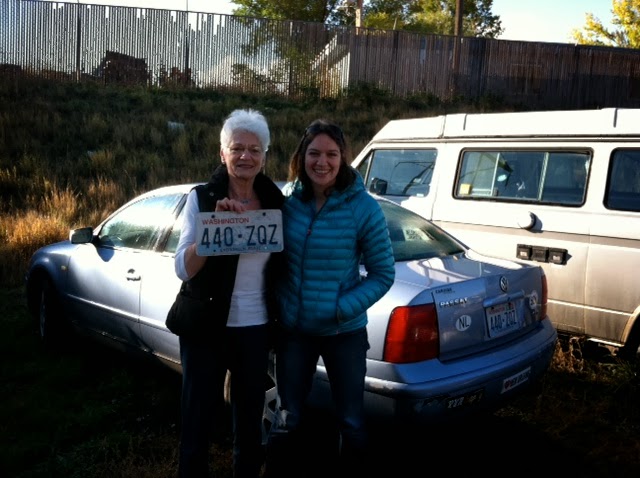
But, allow me some sentimentalism: this month marks the 10-year anniversary of my obtaining Luna Moonshine, the '99 periwinkle-colored VW Passat that's been the only car I've ever owned. And, several days ago, I finally said goodbye and put her to rest in the hands of a VW shop here in Colorado.

Over our shared decade, we traveled roughly 100,000 miles together. She moved with me from Kansas to Ohio to Washington to Colorado. She road-tripped with me to Chicago (twice!), to Massachusetts to visit my good friend Becs and experience Trader Joe's for the first time, to New Orleans for three weeks of hurricane relief work after Katrina, to Kentucky for my very first backpacking trip, to the depths of the Cascadian jungle in western Washington for many a banjo jam session by the river.

She died a few times, including once at the end of a 20-mile gravel road in the woods, after which she had to be hauled out of by Cambajamba's jeep and a four-foot tow rope. She suffered sub-freezing nights in Ohio, rain storms in Seattle, snow storms in western Colorado. She was only ever in one accident. On one of the rare occasions I permitted someone else to drive her (those who know me know I was always protective of Luna), she was rear-ended on a highway exit ramp and had to have her bumper replaced.

In her final years, she cost me a fortune in repairs, not to mention in taking only premium gas for a decade; I'd be lying if I said I wasn't happy to be washing my hands of VWs and hopping on the Toyota bandwagon. But, that won't stop me from making an overly sentimental post here on my blog about our many good years together.

The Kansas days. Christine and Pat and I pack for our first road trip--to Chicago, for Lollapalooza, to see Weezer and Death Cab for Cutie and other high-school favorites. Luna was bumper-sticker galore back then, including but not limited to cliches such as: ART NOT APATHY; Compassion is Revolution; SAVE THE DRAMA FOR YO MAMA; People are Miracles; Every breath is a gift; ENJOY LIFE THIS IS NOT A DRESS REHEARSAL.

My first backpacking trip, in Mammoth Cave National Park, with Sahale, Ezra, Erika and Shari. It rained for 40 hours straight. Magical as the trip was, we cut a planned five-day trek short after three days and I was grateful to Luna for putting the "car" in "car camping" that night. As in, I slept in her front seat that night.

Piling into Luna in New Orleans with Ruth, Anna, Daniel and Adam after a long day of gutting houses.

My commute through northeast Ohio farm country from Oberlin to Elyria for my job at Dick's Sporting Goods--the first job to send me down a running/outdoors-related career path, and also introduce me to some incredible friends outside of the "Oberlin bubble."

Sunset over I-90 in Washington state, the night I arrived in Seattle after a 2000 mile drive from Kansas, and a few days' stopover in Glacier National Park to visit Shari and hike the heck out of some beautiful Montana trails. Real world, adult livin', here I come.

Cruising the streets of my new hometown the next day. Seyeon took this picture from my backseat, because my front seat was still full of moving boxes.

One of my first travel-writing gigs, with OutdoorsNW magazine--road-tripping to Oregon's Willamette Valley to ride my bike, go wine-tasting and write about it for the magazine! Thanks to Carolyn for entrusting me with the assignment.

Luna pretending to be a 4WD mountain car, playing chauffeur to my annual Christmas-in-Seattle tradition with Elodie and James--snowshoeing! In the Seattle years, post accident-and-bumper-replacement, Luna sports new hippie bumper stickers, including but not limited to: Run Happy; Namaste; I {heart} New Orleans; 50k Vashon Ultra.

The neighborhood cats in Seattle loved Luna.

Other creatures have also enjoyed sleeping on, or in, Luna. She played chauffeur to the most magical road trip of all time, out to the Methow Valley for the Angel's Staircase 25K with Tom and Elodie. (Flatlanders running straight up an 8000-foot mountain elicits midday car naps.)

Luna also earned me my favorite parking ticket, featuring the best butchering of my name EVER. I've seen Yikta, Yata, Yakita, Yita, Yika, Yikita ... but this. This was a whole new level.

Luna survives a long, cold, grueling drive from Seattle to Colorado at the beginning of this year for my new gig with Trail Runner.

My mom (visiting from Holland earlier this month!) and I saying goodbye to Luna in the VW lot here in Colorado where we left her.

RIP Luna. Thank you for 10 years of awesome!

Friday, July 26, 2013

Life: The Outtakes Reel

Photo by David Clifford
This week, as I was reviewing photos from my recent "work" trip to run trails in Iceland and write about them, I couldn't help but think, Damn, my life is freaking awesome.

... a sentiment which was immediately swallowed by my ongoing fear that I was once again contributing to that everyone-else's-life-looks-better-on-the-surface phenomenon that I feel, more and more, I want to devote my creative energies to squashing.

Truth be told, following an admittedly amazing week in Iceland (which was on top of an equally amazing long weekend in the Pacific Northwest for the wedding of my wonderful friends, Kate and Jeff), this week, my heart has been heavy. A number of people in my life, both dear friends/family as well as several close acquaintances, have been grappling with tremendous personal challenges, including, but not limited to: cancer, depression, divorce, unsatisfying marriages, corporate layoffs and other assorted rejections.

Thinking about these people I love and care about so deeply has made it difficult to concentrate on the regular, day-to-day aspects of my life. I hate feeling helpless. The ongoing question, for me, seems to be: can I somehow help people feel less alone in their struggles? I've had so many people hold my hand through the darkest periods of my own life in the past; I want to pay that forward. We all deserve to feel as though we are not alone in chugging through this life.

Perhaps it's the only child in me, but there's something especially terrifying to me about the concept of alone-ness. Not solitude, which I consider something different entirelya proactive choice to spend quality time with oneselfbut the case of having alone-ness cast over you, like a cloak. Isolation, alienation. Feeling a lack of connection to others in the world.

With all this in mind, I think I'm finally ready to share a blog post I wrote seven months ago, immediately after I accepted the job as Associate Editor at Trail Runner, but have left hiding in my drafts folder ever since (and, at the time, spun into this one instead ... )

See, one of the things I've felt sad about this week is some "restructuring" at REI's headquarters, through which several friends have lost their jobs, some of whom have been with the company for decades. Despite the fact that I never officially transcended my role as a temporary employee at REI Corporate, I felt very much a part of the family there. So, my heart hurts for them.

On the other hand, in many ways, I feel a lot of hope for those who will be leaving the company, willfully or not. Change, when thrust upon us, is never easyyet it nearly always leads to growth, to some recognition that, in the long run, the change was for the better. I spent a year and a half trying very hard to earn a permanent spot at REI Corporate, certain that being a copywriter there was my ultimate dream job. Maybe, if I'd gotten it, it would have been. But sometimes it's easy to get so wrapped up in the immediacy of our own lives that we fail to recall the big picture of what it is that will really make our souls sing. Not ever being offered a permanent copywriting job for REI is probably the best thing that's happened to me ... after all, I wouldn't have been getting paid to run around waterfalls in Iceland last week if REI Corporate had ever made me a permanent employee.

So, in my effort to remind my friends that change, loss, and not getting what you hoped for can actually turn out to be amazing in its own way ... here's the unpublished blog post from seven months ago:

---

While I've had a number of really fabulous opportunities come my way over the past few years, there have been many disappointments and heartbreaks along the way, too. Today, I feel like writing about my behind-the-scenes, my outtakes reel, if you will, along my convoluted path to my dream gig.

Before I went to college, I had some illusions about becoming a published novelist upon graduating with my creative writing degree. Then, toward the end of my time at Oberlin, I got it in my head to apply for the Watson Fellowshipa $25,000 grant to travel the world for a year and focus my energy on a single project. My project proposal was to travel to Malaysia, Tanzania, Malawi, South Africa, and Suriname, and look at the intersection of long-distance running and humanitarian projects. I wanted to be inspired by the amazing ways that people have used the simple act of running to accomplish so many thingsto spread joy, to supply neighborhoods in need with shoes and other resources, to empower women and kids throughout the world, to raise money for villages and schools and water wells, to bring disparate communities togetherand I wanted to write about those efforts, as well as develop the skill set within myself to launch my own running-based, global nonprofit.

But alas, I bombed my interview with the fellowship committee at Oberlin. I was rejected at the first level of evaluation all Watson proposals undergo. It crushed me.

By the time I graduated, I'd adjusted my ambitions to what seemed like more practical pursuits: getting involved in the publishing industry, copywriting for a marketing team, or possibly working in corporate communications.

But even those jobs were hard to come by, in the midst of a difficult economy. My liberal arts degree  spun me into a poet, but left out the bill-paying kinds of skills that most of us need to survive in the big, bad "Real World."

So I chiseled away even more at my dream, began applying feverishly for jobs that I only sort of wanted, in any part of the country I could even vaguely see myself living. Still living in rural Ohio at the time, uncertain I had the money to move to a new place without securing a job first, I felt scared, and increasingly desperate.

Reed College, in Portland, interviewed me for a job in their admissions office. They turned me down.

When I applied for a one-year communications fellowship position with the Oberlin Office of Communications, I didn't get offered an interview.

YES! Magazine wouldn't even entertain my application for an assistant editor position.

Brooks Running didn't want me.

A marketing agency called Merkle interviewed me for an editing job and I never heard from them again. There's nothing worse than getting rejected from a crappy entry-level job with a marketing firm that's light years away from your true passion. But, that happened. A few times.

Heck, I couldn't even get Road Runner Sports to talk to me about a $10/hour "Running Specialist" job hawking shoes.

I was spiraling to the bottom of my dream funnel.

The day Reed rejected me for the admissions job, I hit a pretty bad low. So I took a step back and asked myself, "If I could have any job in the world right now, what would it be?"

... and found that my answer, at that time, was, Writing and editing for an outdoorsy magazine in Seattle. So I decided two things: One, I was going to move to Seattle, no matter what. Two, I was going to reach out to Carolyn, the editor of a magazine called Outdoors NW that I knew was published in Seattle. Their website didn't even have a section for jobs or employment, but I figured I could learn a thing or two from someone who'd been in a pioneer in the world of outdoors journalism for decades.

The next day, my dream funnel began opening back up: Carolyn wrote me back and offered to meet me for coffee and chat. (I hadn't even moved to Seattle yet!) When I did finally move and meet up with Carolyn, we hit it off instantly, and she gave me my first freelance writing assignment, putting together some book reviews. So began my own fledgling career in outdoors journalism.

(One more "rejection" worth noting: I wrote to the magazine Northwest Runner around the same timeThey never responded to my email.)

Small successes began building: 24 Hour Fitness hired me as a front-desk minion (which I quit after one week with that horrible company.) REI hired me to work part-time, seasonally, in their flagship Seattle store as a sales specialist in the footwear department. Outdoors NW magazine eventually brought me on as an assistant editor. I made it through an "audition" with Kaplan Test Prep to work as a private SAT tutor for high school kids in the Seattle area, and survived four weeks of intimidating tutor training, designed to weed out anyone who was too nervous or insecure. I couldn't sleep at night for a whole month, I was so terrified of failing ... but I made it.

Yet, the stumbling blocks were far from over. The next year, I landed the temporary copywriting gig at REI, but was sent back to work retail at the store when the team's freelance budget for the year ran out ... invited back to the corporate offices at the beginning of the following year, but nevertheless strung along as a temp for another full year.

I applied for a digital content manager position with the Washington Trails Association, my favorite nonprofit in the Northwest—and though I was fortunate enough to be one of only a few people interviewed out of the nearly 100 who applied, ultimately they went with someone else as well (though, notably, offered the nicest rejection ever, which left me feeling warm and fuzzy about the whole experience, and equipped with honest, helpful feedback on why they'd gone with another candidate.)

But it still hurt. I can't tell you how many times that week I reread the words of Max Ehrmann from his 1927 Desiderata poem: "Whether or not it is clear to you, the universe is unfolding as it should."

Fast forward a year, and after all that, I've finally landed the gig I always wanted in the first place.

Career musings in my personal journal, circa 2011

The experience of failure, by the way, does not go away with earning a job title. This week, even with the best intentions, I managed to do a disservice to an amazing athlete by writing a headline that felt too much like a "bait and switch" to several disgruntled readers (including several folks in the greater trail-running community whom I've long looked up to), who didn't waste a moment letting me know in the comments section they thought my headline was lame.

One stroke of acceptance does not insulate us from criticism. But, with criticism come lessons, and with lessons comes growth. At least that's what I keep telling myself, anyway ... :)

Ehrmann's poem concludes: "With all its sham, drudgery and broken dreams, it is still a beautiful world. Be cheerful. Strive to be happy."
Watching sunrise from the summit of Mt. Sopris (12,966 feet) this week