Showing posts with label seasons. Show all posts

Monday, November 10, 2014

Pinhoti 100 Race Report: The "Perfect" Race

Peak bagging in Alabama! Thanks to fellow runner and five-time Pinhoti 100 finisher Perry Sebastian for snapping this photo of me around mile 40.
Last weekend, I re-learned a lesson I've already been taught many, many times, but somehow keep forgetting: the key to satisfaction is low expectations.

And, in the case of running 100 miles, also: patience, humility, and a sense of humor.


When I first signed up for Pinhoti in Alabama's Talladega National Forest, still in the wake of my slight-disappointment over how the Bear 100 went at the end of September, it was with a plan: rest completely for one week, train hard again for three weeks (favoring intensity over volume, so lots of speedwork, hill repeats and strength training), taper one week, then crush Pinhoti.

Instead, here's what happened during those five weeks: a couple yoga classes, an 8-mile hike, a few 45ish-minute easy runs and a 12-mile long run. No speedwork, no hill repeats, no strength training. In the seven days leading up to the race, I ran zero miles.

Truth be told, I just felt over it. I signed up quietly for Pinhoti within hours of publishing my Bear 100 race report, felt excited about running another 100-miler for approximately two days, and then regret sunk in. I felt like I just really didn't care anymore. I'd trained hard all year, I was tired, I felt ready to focus my energy on other pursuits for the rest of the year.

It's not an inspiring message, but it's genuinely how I felt. When Pinhoti race weekend rolled around, I no longer harbored any expectations of "crushing" it. I chose, instead, to define my goal not necessarily as nailing a perfect race, but as just what I articulated on my blog last month: "to just not fall apart ... to run hard and feel (mostly) good the whole time, or as (mostly) good as it's possible to feel during a 100-mile race." 

Because I had no crew or pacer, I wasn't worried about projecting my times or hitting any targets, other than staying ahead of the race cut-offs. I admit to not even really looking at the course profile before the race.

When the race began at dawn in a 32-degree chill on Saturday morning, I took it easy. I hung out in the back of the pack, didn't get frustrated when I got stuck in a slow conga line on singletrack for the first few miles, just relaxed and reminded myself to run slow, slow, slow.

What the Pinhoti Trail looks like on Instagram. But seriously. It's this beautiful. (I cross-posted this image to the Trail Runner Instagram page.)
As the sun came peeking through the trees, we runners spread out enough that I got into a groove. The first 40 miles of Pinhoti are smooth, runnable singletrack without any of the significant, gut-busting climbs that make up the trails on which I train at home. Not that it's flat, by any definition. Just steadily rolling, with one big push up to the top of Mount Cheaha, Alabama's highest point at 2,411 feet, around mile 40.

Several notable things about Pinhoti that set it apart from most other 100s I've run, volunteered, paced and/or crewed at (which include: IMTUF, Leadville, the Bear, Pine to Palm, Cascade Crest, Badger Mountain, Pigtails and Hardrock): 

1. The leaves.
The singletrack is lovely and carpeted with fallen leaves this time of year. I was very grateful for the toe bumpers on my shoes, which saved my feet from many a bump and bruise. I tripped over hidden rocks and roots at least a few dozen times, but only face-planted onto the ground once, after stepping on what I like to call a "leaf cornice" on the edge of a particularly narrow strip of singletrack cut into the side of a steep slope. I thought there was solid ground underneath the leaves on which I stepped; alas, there was not, and down I went. No serious injuries, though.

2. The number (and quality!) of aid stations.
Pinhoti has 18 aid stations, far more than most 100-milersand this is both a blessing and a curse. A blessing, because the aid stations are unbelievably amazingliberally packed with not only the usual ultra trappings, but all sorts of goodies like doughnuts, bacon, sausage, pickles, homemade cookies, Nutella wraps, fresh vegetables and hummus, whiskeybut a curse because it's easy to lose time hanging out. Because I had no crew, though, and know virtually no one in the state of Alabama (save for Ms. Brandi Garcia, whose smiling face greeted me and brightened my day at many an aid station!), I never sat down and rarely spent more than about 60 seconds at any aid station, except to swap out my shoes at mile 55, which kept me at that aid station for maybe five minutes.

3. The runnability.
Since I often train at altitudes two miles above sea level, my lungs felt like a million bucks the whole race. i.e. Colorado people should be given a serious time handicap at sea-level races, because breathing that much air felt like cheating. My legs, on the other hand, had literally never done that much concentrated running everI've averaged 40-mile training weeks all summer long, and even the majority of those training miles are hiking, not really much "running," per seso by the end of Pinhoti, my legs were definitely worked. But all that running felt damn good, too. So much gorgeous singletrack.

4. The long, long night. 
After the sun went down in blazing, red glory, we didn't see it again for a long time.
It got dark on me somewhere around mile 45ish for me, and by the time it was light again, my race was nearly over. Because Pinhoti occurred later in the year than any other 100 I've run, the daylight hours were much shorterand because I ran this one much faster than any other 100, despite its benevolent 7 a.m. start time, I finished quite early the following morning, by comparison. I love night running, but I've also always greatly looked forward to sunrise on the second morning of hundos, because it's such a natural energy boost and mood lifterso sometimes it was hard to spend such a long night out there alone, knowing that sunrise was still so many hours away, and that I'd spend almost the whole second half of the race running in the dark.

5. Bottom line: If anyone ever wants to try a pacerless/crewless race, this is the race to do it at! 
People in Alabama are nice. Here's me chatting up a storm with folks at an aid station, while simultaneously shoving copious amounts of snacks into my face.
It's also just a great beginner hundo. Beautiful fall weather all seven years it's been held (no capricious high-alpine storms to contend with), plenty of drop-bag opportunities (I used four drop bags in total), and amazing volunteers and aid-station support. I carried a small pack, mostly for extra clothing layers and some snacks, and one handheld bottle; I rarely drank more than its 20 ounces' worth of water between aid stations, so it's really possible to do this one with minimal supplies.

6. With that said, for those planning to run this in the future and trying to figure out what to pack, here was my complete gear supply list, keeping in mind that forecast was for 30 to 60 degrees, high wind but no chance of rain. My base running costume was just shorts and a PEP merino wool T-shirt (short-sleeve version of this one), but I also had with me at all times (sometimes wearing, sometimes stowed): a long-sleeve wool shirt, a lightweight windproof jacket, full-length tights, a Buff, earwarmer headband, and lightweight fleece gloves. I also carried with me the whole race my Suunto Ambit 2 (which utterly failed, dying less than 10 hours into the race after a full battery charge; strange, because it lasted all 31+ hours at the Bear on the same settings), point-and-shoot camera, Black Diamond Icon headlamp (it's heavy, but so worth the extra ounces to not struggle to see the trail at night), just-in-case spare headlamp, a bunch of spare batteries, a couple Band-Aids, a mini tub of Vaseline, and ample snacks such as squeezable packets of pureed baby-food, bars (I favor nut-based ones like KIND and Clif Mojo), dried fruit leathers, a few Vespa packets and Endurolyte sodium tabs that I took sporadically (probably 10 during the whole race).

Here are a few photos I took with my camera during the race that really capture the beauty of Alabama's trails and all the sunlight filtering through autumn foliage:


I did have some early twinges of paina dull, inexplicable ache in my right knee that started around 35 miles, and persisted until mile 50ish when it was overshadowed by a sore left Achilles for the next 5 miles or sobut I have been through enough of these things by now to know those small pains almost always pass if you are patient with them. I don't take Ibuprofen or anything like that during races, so my only defense against pain was really my own patience. So, to my mind, I'm ever grateful; the rest of my race was fairly pain free.

All smiles (almost) all the way! Photo by Brandi Garcia.
Frankly, all I tried to do was have fun. I talked a lot with fellow runners, I smiled and laughed at every available opportunity, I joked around with all the aid-station volunteers—my favorites were the women at Hubbard Creek, mile 52ish, who were tickled pink when I saw the plate of raw broccoli stalks and hummus they'd set out on their aid-station table. I exclaimed, "BROCCOLI?! I LOVE BROCCOLI!" and dug in, and they got excited, because I was the first runner to pass through who'd been stoked on the broccoli.

A mile later into the woods, as I passed another runner and his pacer, they called out after me to say they wished they could run that confidently at night. Then one of them said, "Hey, wait a minute, that's Broccoli Girl! Damn, I should have some broccoli, too, if it makes you run like that." The other said, "I just ate a bunch of bacon there, instead of the broccoli. The bacon's holding me back!" I yelled over my shoulder that I'd eaten plenty of bacon at the aid station, too, but also that yes, broccoli is awesome.

I'd had this suspicion before, that running a race sans pacer or crew would force me to stay more positive overall, to maintain my joy and my humor, and above all, to stay strong mentally rather than relying on someone else to do that for me. Steve was a wonderful pacer for me at my first two 100s, but I found myself using his presence as an excuse to complain about everything that was bothering me, to garner his sympathy, to cry on his shoulder. He was kind and reassuring and coached me through my low moments, but the point is, when you're running alone, you can't let yourself fall apart in the same way. If you want to finish, it's simply not an option.

And so, there was no falling apart this time. Not to say I didn't come close a couple times, though.

Just before the sun came up, I was beginning to get tired and loopy. I kept saying (yes, aloud) to myself, "Stay focused; you cannot lose your shit now." Despite my best warnings to myself, I was seriously loopy, so somehow managed to accidentally leave my gloves and handheld bottle in the middle of the woods after a quick break around mile 82. I just plum forgot to pick them back up when I started running, and didn't realize it until over a mile later.

To my horror, I thought I'd also dropped my rental car keys somewhere in the woods, because I couldn't find them anywhere in my pack—so I spent several miles alternately berating myself for being such a careless idiot, then telling myself to calm down, because as Scott Jurek once wrote (forever one of my favorite quotes about ultrarunning), "The ultra distance leaves you alone with your thoughts to an excruciating extent. Whatever song you have in your head better be a good one. Whatever story you are telling yourself had better be a story about going on. There is no room for negativity.  The reason most people quit has nothing to do with their body.” But even this, I managed to push onto my mind's backburner, focusing instead on the beautiful scenery and gratitude toward my body for being capable of this sort of thing. (Fortunately, after finishing, I found my car keys buried deep inside my pack.)

If I can take away just an ounce of the meditative calm and wisdom I somehow find during ultras and apply it to the rest of my life, I'll be a lucky little lady indeed.

By mile 85, I was still feeling fantastic. I could smell the barn, too, so I kicked things into high gear. I had a blast running hard for about seven miles before my body decided that was enough, and it was done. Oops. Thus, the final eight miles were quite a bit slower going, mostly walking. A good deal of those miles are on paved or gravel roads, so in theory, though, if one were to save anything in their legs for the home stretch, there's ample opportunity to run 'er in.

Morning frost on the relatively flat final miles of the Pinhoti 100 course.
I crossed the line in 25:57—a pleasantly surprising "PR" for me by a full three-and-a-half hours, but far more importantly, the most joyful and least emotionally wrecked I've ever felt at the finish line of a hundo. Pursuit-of-the-"perfect"-100 mission accomplished! I'm now content to retire from my 2014 running season and turn myself over to the gods of winter for a season of snowboarding, cross-country skiing, Swiss Bobbing and other non-running adventures!

Not a homeless person: Just a tuckered out ultrarunner. It's not the first time someone with a camera has taken a post-race snap of me. Thanks, Brandi! :)
Big thanks, as always, to everyone who supported me from afar at this race—Steve, my parents, my friends, my coworkers, my comrades in the ultra community, my Colorado running buddies Annie, Jeason, Elinor, Julie, and Jen—as well as all the spectacular folks I met or hung out with in person in Alabama last weekend, including my wonderful host Marnie, fellow runners Vanessa (three-time Pinhoti finisher) and Donna (first-time 100-mile runner and finisher), Brandi, Perry, Rich, all the volunteers (especially the purveyors of broccoli at Hubbard!), RD Todd Henderson, and the many more good folks I chatted with but whose names I didn't learn. Y'all are awesome!

Tuesday, September 9, 2014

Is ultrarunning—or any other great passion in life—sustainable?

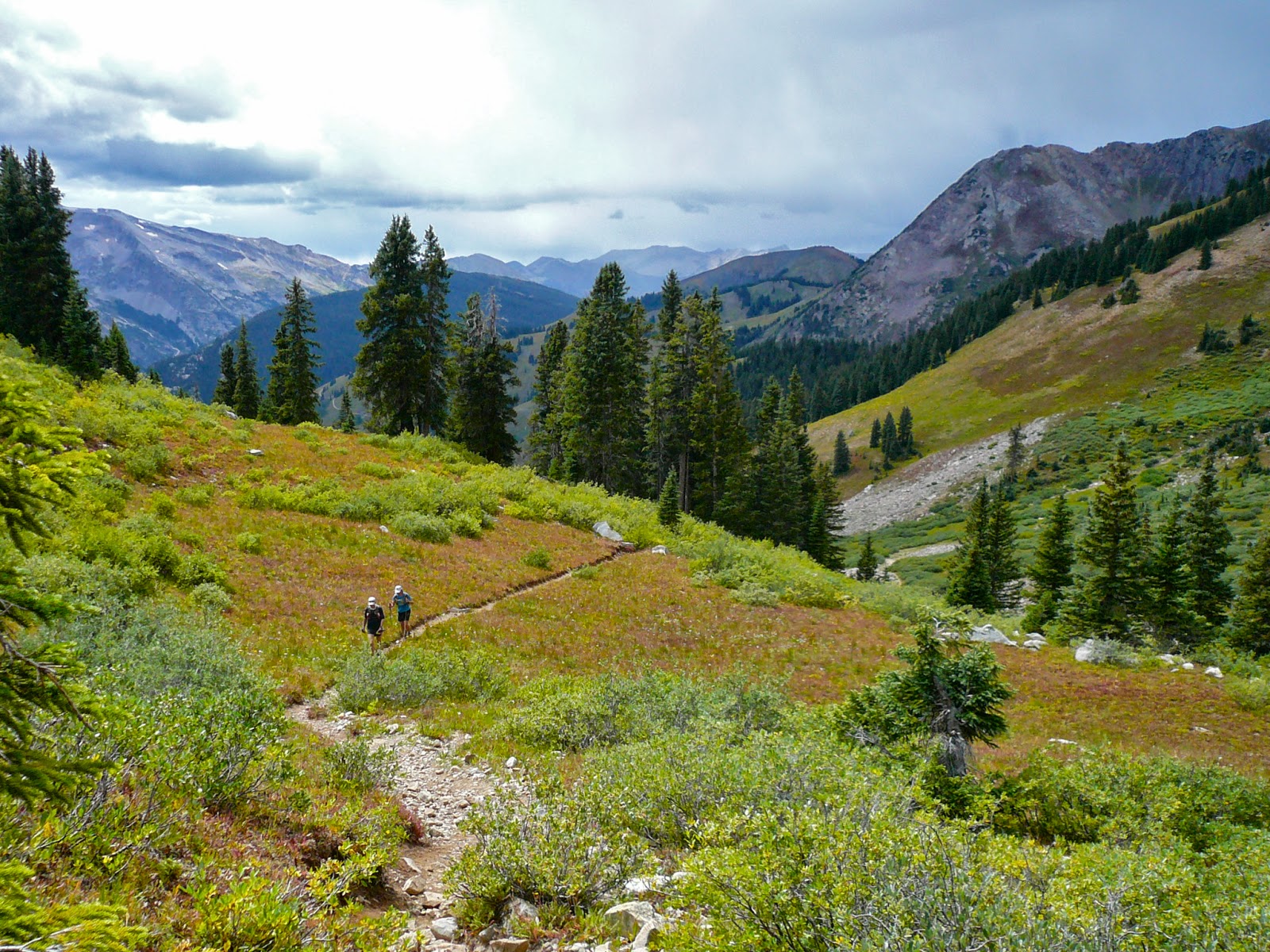
Scenes from running Colorado's infamous Four Pass Loop last Sunday.
Fall is no doubt in the air here in Colorado. The aspen leaves are paler than ever after a summer basking in the sunshine, faded from their original deep green to a sort of lime-y yellow, well on their way to the fiery hues that bring “leaf peepers” from all over the world to Colorado in droves come late September. I’ve been waking up and seeing my breath in the air in the mornings, and nearby, the tops of our local 14ers in the Elk Range have already seen their first dusting of snow.

Frost up on the trails near Aspen early in the morning on Sunday.
I admit I’ve been dreading the end of summer. Don’t get me wrong; I adore fall—if only it weren’t followed by Old Man Winter. As previously mentioned, winter in the mountains has proven rough for me, since it invariably means the end of trail-running season here, and the beginning of a six-month stretch during which I must find other sources of the things that I typically glean from running in the mountains: endorphins, stress relief, meditation, a sense of community, empowerment, goals to strive toward, races to look forward to, excuses to eat lots of food.


Because I’ve been training for months for the Bear 100 (now less than three weeks away), like any good ultrarunner I’ve been geeking out on just about all forms of data and media about the race that I can find to consume ahead of time … race reports, spreadsheets of results, photo albums, and most recently, this documentary, ‘Dancing the Bear,’ which covers the 2004 Bear race.

Here’s what struck me about the film: many of the runners featured are no longer running ultras.

(Thanks to the fairly comprehensive resource, ultrasignup.com, it’s possible to, however creepily, track these things; please note that all my following observations are based on Ultrasignup results, not on rigorous, journalistic research; if I’ve made any erroneous conclusions here, please let me know.) The winner that year, Larry O'Neil, for whom it appears the 2004 Bear was his first 100, ran one more hundo in 2008, a couple shorter-distance ultras in 2010, then nothing since then. Chris Estrem, who took second that year, never ran another ultra again.

Of the two women the film followed—who both spend much of the film waxing poetic about their love for ultrarunning, discussing how essential the sport is to who they are—one never ran another ultra after that year. The other continued running ultras (though only one more 100) sporadically until 2010, then again, no more. Another runner the film featured, then-15-year-old Jimmy Wrublik, ran a few more ultras, but stopped after 2007.

There are, of course, plenty of ultrarunners who’ve been in this sport for decades—including three who also show up in ‘Dancing the Bear.’ The first: Betsy Kalmeyer, who started running ultras in 1988, won the Bear twice (including in 2004) and most recently, at the age of 53, took second at the 2014 Hardrock 100. The second is Errol "The Rocket" Jones, who's been running ultras for more than three decades and, at age 64, is still going strong. The third is Hans Dieter-Weisshaar, who ran his first 100 in 1999 and has since bagged more than 100 100-mile finishes, including, just last year, over the span of a few months, Hardrock, Leadville, Cascade Crest, Wasatch and the Bear—at the age of 73.

We champion these inspirational figures—and rightfully so!—as proof that ultrarunning can be a lifelong sport. After all, you don’t see too many football, soccer or basketball players still competing in their 50s, 60s and 70s.

And yet, sometimes I question whether ultrarunning—particularly 100-milers—is such a sustainable sport after all, at least for most of us. I understand this is relative blasphemy for me to utter, as I am myself extraordinarily passionate about the sport. I have dozens of ultrarunner friends older than I am, who’ve been doing this for many years already, and inspire me to no end—but indulge me for a moment here.

Having not spoken to any of the 2004 Bear runners featured in the film who are apparently no longer doing ultras, I can only speculate on what made them walk away from the sport. But, consider this: even for a low-mileage (relatively speaking) ultrarunner like myself, I typically spend 10-15 hours/week running on trails. I don’t have kids or many obligations outside of my job. Though many of my ultrarunner friends have young kids and seem to make it all work, I have a hard time imagining how I could ever, on a longterm basis, balance parenthood with ultrarunning and work and other priorities in my life, like being fully present in my relationship, having time for friends and family, getting enough sleep, eating well (by making food from scratch rather than relying on processed foods), writing, reading books, traveling, and keeping some modicum of organization and cleanliness to my living space. At some point, some aspect, somewhere, has to suffer.

Trail and ultrarunning, of course, has improved my life in a myriad of ways which I’ve already expounded on at length on my blog. Yet, as a still-starry-eyed relative newcomer to the sport (I’ve only been running ultras for a little over four years now, after all), I can’t help but notice that, for many, the actual shelf life of this sport seems to be about as many years as I’ve already invested in it.

Two things stuck out to me from my interviews last year with accomplished ultrarunners Jenn Shelton and Scott Jurek for an article in Trail Runner about the folks who appeared in the bestseller Born to Run. One: when I asked Jenn what she thought the future of ultrarunning was, she was very quick to tell me that she doesn't think it's a sustainable sport for most people. She was probably the first ultrarunner I ever heard express this out loud, since most of us like to talk about how of course ultrarunning is exploding in popularity and will continue to do so indefinitely because, duh, it’s the best sport in the world. But Jenn … Jenn just said, “It's hard to say anything without looking like a jerk, but I'm not sure it's meant to be a really popular sport. The time commitment to properly train is well beyond most people's lifestyle."

When I spoke with Scott, he spoke at length about the personal burnout he feels surrounding racing: “Do I get as much out of racing, to go after a time or a win anymore? I don’t know. It’s harder to have that ego now. I’ve enjoyed that pressure in the past, because it’s pushed me beyond boundaries, but at the same time, it gets harder as I’ve gone to the well so many times.”

This is probably what I find most compelling—the sheer time and mental energy we devote to plodding through the mountains for hours, sometimes days, on end. How deep are our reserves, and what do we do when they run out? How long can we find meaning and purpose in doing, essentially, the same thing over and over again? How long can we make running our highest (or almost highest) priority, at the necessary expense of other aspects of our lives? And, if we someday find we’ve lost some of our passion, how do we renegotiate whole identities that have been built upon a foundation of running?


Every run (as with all activities we choose to participate in) is, ultimately, a decision to not to do something else, whether that means relatively unproductive alternatives, as many drug-addicts-or-alcoholics-or-otherwise-turned-ultrarunners can attest to—or whether it means valuable ones, such as spending time with our families or (non-runner) friends.

My friend Jenn Hughes recently grappled with this very issue in a beautifully written, heart-wrenching blog post about running the Fat Dog 120 in Canada. At the start line, her 7-year-old son, Colin, protested to her: “You’re always leaving me.” Haunted by those words for all 120 miles until the finish, she writes, “I crossed rivers, ran through fields of heather, met new friends, and graciously accepted handmade food made from far flung aid stations … but it all felt like a game, a silly diversion … It was the most empty, neutral, underwhelming race finish I could have ever imagined, devoid of any excitement after all the pain I had just gone through. What exactly was the point?”

While poking around on Google for beta on the Bear 100, I also stumbled on the blog of Shawna Tompkins, who used to race up to a dozen ultras a year—and win most of them. I was surprised to learn she hasn’t (as far as I can tell, from Ultrasignup) raced any ultras since her second-place finish at the 2012 Bear. In the most recent entry on her blog, from August 2012, she writes about DNFing at both White River 50 and Cascade Crest 100 that summer, after having won the San Diego 100 in June: “I am not really sure what is going on, but my inner strength seems to be laying on the trail at San Diego or something …  I cannot figure out my thoughts!  Sure not good at this stuff.  Work hard, be tough, it all pays off.  What do you do with yourself if you don't feel like working hard?  Where does that satisfaction come from then?”

It’s hard for me to read things like this, because I’m currently so enamored with the idea of making a lifelong go of this and continuing to draw the joy and meaning from it that I currently do—but who can know? Maybe it’s not bound to be a lifelong sport for many of us, after all. Maybe it’s just something that grabs hold of us for a while, takes us for a wild ride, teaches us strength and resilience, connects us with a slew of amazing fellow humans, then lets us go again, scattering us back out into the world like dandelion seeds to apply to the rest of our lives everything we’ve learned on our sleep-deprived stumbles through the woods.

Or, maybe there's middle ground to be found. Perhaps the solution lies among the yellowing leaves fluttering to the ground outside my window right now. Last fall, my editor colleague at Rock and Ice, Jeff (who loves climbing more than anyone I know) mentioned that, much as he laments the end of rock-climbing season here, he embraces winter, too. It grants him the opportunity to turn inward and focus on other passions for a season—in his case, music and writing.


So, maybe winter in Colorado is just the universe stepping in to help protect me from running burnout—telling me to chill out, take a necessary breather for a few months, reallocate those 10-15 hours/week to other passions so that, come spring, I may return to the trails with a full and eager heart. Absence, after all, makes the heart grow fonder.

But, in the meantime ... I can't help but be anything but psyched for the Bear a few weeks from now.

Standing at the edge of Logan Canyon, home of the Bear 100, after a course-scouting training run last month.

Friday, May 3, 2013

A Love Note to the Seasons

Several days ago, one of my coworkers came back from a sultry lunchtime run, panting, drenched in sweat, and said, No more lunchtime runs for me. It’s no longer the season, I guess, now that noon here on a sunny day generally sees temperatures in the high 70s or low 80s.

In contrast, last summer in Washington, after a long mountain run in the middle of a cool, cloudy day of what I recall to be July-ish, my good friend Tim proclaimed, “Today was awesome! You know you must be a real runner when you’re grateful that it’s overcast so often in Seattle!”

And indeed, for all my years in mild Seattle, I was far too busy being giddy about having escaped Midwest summer humidity and bitterly cold winters to consider what I might be missing. Yet, now that I’m living in place that once again has very distinct seasons, I feel grateful for them—despite dreading summer temperatures forcing me to give up the lunchtime runs I've so been enjoying this past month.

And ... random snowfall on May 1 = not cool, Colorado! Forgiven, only, by the fact that it was sunny and all melted by 3 p.m.
Perhaps it’s once again a case of cognitive dissonance, of my trying to see the best in whatever situation I find myself in, but watching Colorado transition from winter to spring to what feels like summer (at least on days like today) has been pretty darn mesmerizing.

When we moved here, Redstone was silent, semi-deserted, muted by the snow:


Now, it looks like this:


Slowly, seasonal residents have returned, tourists have come to visit, and the town feels as though it’s come alive. Across the street, the Crystal Club CafĂ©—all shuttered up in the winter—opened for business for the season today. Tonight, there are lights and voices and laughter outside … children playing corn hole, bikes flying down the street, music playing, the happy clink of pint glasses.

Trails are (finally!) opening up for running. 


I’d been lamenting the fact that the only places I’d run here yet were all dusty, exposed desert trails, scattered with twisted juniper trees and sage bushes—beautiful, no doubt—but not like the deep, lush, fern-and-moss-laden forests of Washington that I love. Last weekend, though, I ran the Avalanche Creek Trail out here for the first time, and was amazed to find myself running under a canopy of tall pines that felt far more Washingtonian than Coloradoan. 


There are still snowy patches here and there, but soon enough, it’ll be a spectacular 24-mile out-and-back to a series of alpine lakes … and with a trailhead just five minutes away from home.

The Crystal River has risen tremendously in the past few warm weeks, as snow has melted off up high and transformed the Crystal from a trickling creek into a roaring river. 

Taking a short break on a run near the "Meatgrinder" Class V rapids
We can hear the river now from our living room windows. Earlier this week, our beloved hot springs down the road disappeared for the summer, as the river level has risen and rushed right over the top of it—but it feels okay; it will come back when the water falls again for autumn.

Seasons are soothing in this way. They’re predictable, but not so much that they’re lacking the delight of small surprises—the sound of birds in the spring, the first summer night that permits a nighttime stroll in a T-shirt, the turning of the leaves in autumn. Seasons are an antidote to stagnancy; they promise forward movement, without threatening irrevocable change. No matter how drastic the season is, you can be sure that it, too, shall pass.

It’s different from the kind of changes we experience in our lives, which are indeed often both unpredictable and irrevocable—for better or worse.

2012 saw more changes in my life than any other year recently. Not counting miscellaneous freelance projects I juggled, I went through three different jobs—four, if you count the new one I started in January 2013. I experienced the end of a 3.5-year relationship and the beginning of a new one. My income fluctuated wildly. I went from having run one ultramarathon a year in 2010 and 2011 to running more than a dozen in 2012. I moved to a new apartment last summer, then six months later, moved halfway across the country. Needless to say, by the time I got to Colorado, I was a little tuckered out, and ready for some steadiness.

And very quickly, I cultivated just that—living in a quiet town in the mountains, going to work five days a week, doing all my runs on pretty the same couple of snow-free trails, settling into a peaceful evening routine at home of cooking and crossword-ing with Steve.

While much comfort can be derived from this kind of stability, the flipside is that it can also feel awfully scary. Even if you enjoy your routine, you might wonder, So … is this the way my life is going to be forever? Given that I’ve struggled a good deal in the past few months with homesickness for Seattle, wondering if I’ll be able to make the same kind of friends out here that I had there, the prospect of nothing ever changing again hasn’t exactly been a thrilling one.

We need change to continue thriving. The seasons are reminding me of this. I feel fortunate to have Steve in my life, to feel the warmth of an amazing support network of friends even from hundreds or thousands of miles away, to have the kind of job I’ve dreamt for years about having...

Tough day at the office last week! Our gear guide photo shoot, part I at Mt. Garfield
Gear guide photo shoot, part II, Grand Junction, CO
...to have a home I love coming back to at the end of the day … even yes, I feel lucky to have a hungry kitty who, without fail, paws me awake at 5 a.m. every morning for breakfast.

Gratuitous Chloe photo
What I’m learning out here is that I can have these big rocks in my life that anchor me, while still pursuing growth. I can be stable without being stagnant. 

In closing, I’d like to state that while I still believe Seattle is the best place on Earth to be a long-distance runner, I am eager to see what Colorado's got in store for the summer. It's a tall order to compete with Seattle, where there are hundreds of miles of amazing singletrack in the city or within 30 minutes of it, that stay mostly snow-free and runnable year-round. Trails don’t get shut down for eight months a year to help preserve elk herds. It never gets hot enough in the summer to make midday runs uncomfortable. It never gets cold or snowy or icy enough in the winter to make runs unbearable. And as for all the rain … personally, I always feel like a million bucks when I go running in the rain—like my own personal sprinkler cooling me off every step.

However. I’ll admit that the sunshine out here has wooed me—and I move forward with an open mind. Come on, Colorado … I’m here, I'm optimistic, I’m ready to love you, too … show me whatcha got.

Chair Peak, Crystal River run-off in the foreground, as seen from Redstone this evening